MJUC
variable-tube* compressor
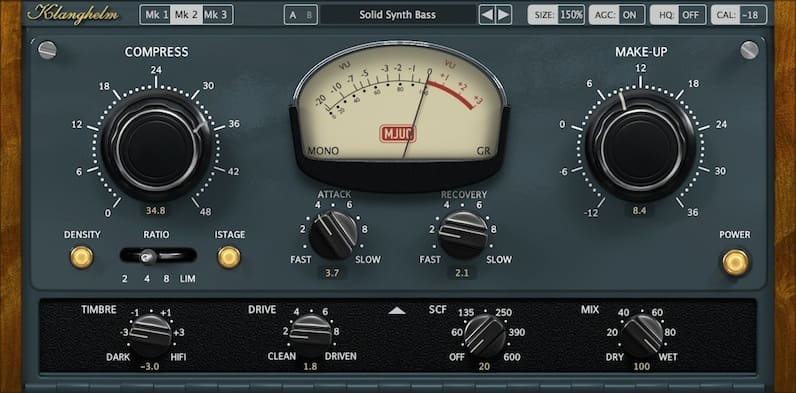
MJUC is the most effortful
Klanghelm plugin to date. It took almost two years
of extensive, dare I say "excessive", research and
development. To
create MJUC I've
researched and analyzed each and every variable-mu*
implementation I could get my hands on to get the
best of tube compression into a single processor. In
order to do the diversity of this compression
topology justice, three different models have been
built. These are kind of a time travel though the
history of tube compression to capture the essence
of each generation. Each model has its own dedicated
signal path and dedicated control set. If desired
you can tweak the overall tone and saturation of
each model with the unique TIMBRE and the DRIVE
knob. DRIVE controls the load of the input and
output transformers as well as the saturation of the
tube gain stages, if applicable. The TIMBRE
extends MJUC's use as a tone
shaper.
Windows (64bit): VST, VST3, AAX Native for ProTools® 11 or
higher
macOS: AU, VST,
VST3, AAX Native for ProTools® 11 or higher
* actually, "variable-mu" is the correct technical term for this compressor topology, but this term is also a registered trademark by Manley Labs®. When the term "variable-mu" is used here, it just refers to the technical correct term for this more than 70 year-old compressor topology. It is in no way intended to be confused with the product of the same name
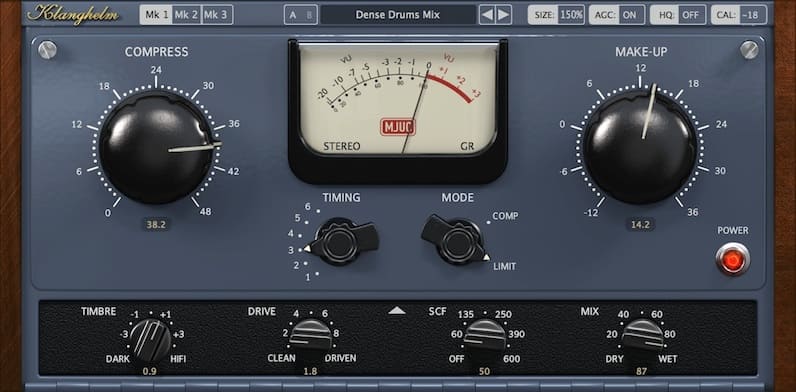
Model Mk1 is based on
the very early variable-mu* designs from the
50s. Due to its extremely high control
voltage it doesn't impart any audible
"thumping", most other variable-mu* designs
suffer from at high GR and fast timing
constants. Also it has a very simple signal
path, where the compression happens directly
in the audio path. The result is a very
natural compression character with very
little distortion. The arrangement of
four(!) variable-mu* stages add to the
incredibly dense and thick nature of Mk1.
Mk1 is the most colored of MJUC's models.
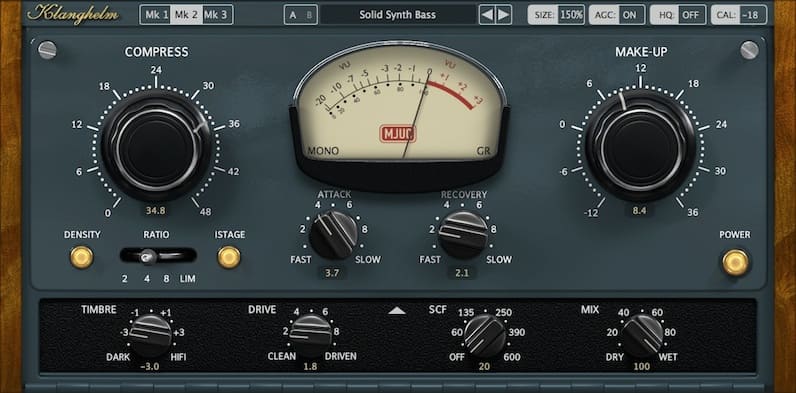
Model Mk2 is built
upon the more complex designs of the 175 and
176 from the early 1960s, the
all-tube-predecessors of the classic 1176
FET compressor. It offers four ratios, a
density switch, that enables a second
variable-mu* stage and reduces the program
dependence of the attack and recovery
timings to a minimum. Furthermore, it lets
you activate the interstage transformer to
reduce overall noise and distortion and
making the compression more accentuated.
Compared to Mk1 the second model is less
Jazz and more Rock'n'Roll with enhanced
generated harmonics and a more forward
sounding character.
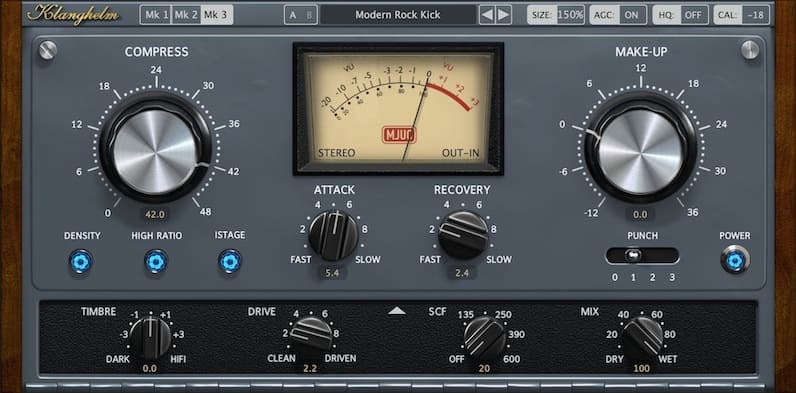
Model Mk3 is the least
colored and most Hi-Fi-sounding model in
MJUC. It is Klanghelm's modern
interpretation of this compression topology.
The only design idea derived from another
modern famous variable-mu* comp is, that
it's circuitry is done entirely
differential, making the unit very quiet and
almost distortion-free. But the real special
thing about this model is, that the actual
compression is done by two different
variable-mu* stages, which kind of work
against each other, one works feedforward,
while the other in a feedback configuration.
This results in a attack accentuating,
punchy compression, surprisingly closer to a
British G type bus comp than to a 670.
* actually the correct technical term
for this compressor topology is
"variable-mu", however this term is also
a registered trademark by Manley Labs®.
When the term "variable-mu" is used
here, it just refers to the technical
correct term for this more than 70
year-old compressor topology. It is in
no way intended to be confused with the
product of the same name
The first examples demonstrate how the
different MJUC models perform on
an acoustic drums phrase: first dry, then processed
with each of the models. In each clip the
only the respective model was used on the
kick drum, snare drum, overheads, room
channels as well as the drum bus. No other
processing involved.
Then
you hear the different models of MJUC on
a full mix. To
demonstrate the differences the examples are
quite a bit more compressed than you'd
usually do. MJUC shows about 6 dB GR in each
example.
Next are some
clips to demonstrate MJUC on electric bass. The differences between processed and
unprocessed are fairly subtle, although each
processed clip shows a gain reduction of
around 10 dB.
And finally
MJUC on slow drums. Just like in the first
examples only the respective model was used
on the kick drum, snare drum, overheads,
room channels as well as the drum bus. No
other processing involved.
Downloads
Download the manual for more information
French version of the manual
(kindly translated by TATOO MANDARINE studios)
Download the free MJUC jr
MJUC jr. is the little brother of
MJUC, a mixture of the models Mk1 and Mk2.
It'll give you an idea, how MJUC performs
quality-wise and CPU-wise. If MJUC jr. runs
smoothly for you, the big brother will do
the same. Also, if you like what MJUC jr.
does, you'll love MJUC.